Progressive upper-lung scarring on screening CT linked to higher mortality: new paper in The Lancet Medical Imaging & Theranostics
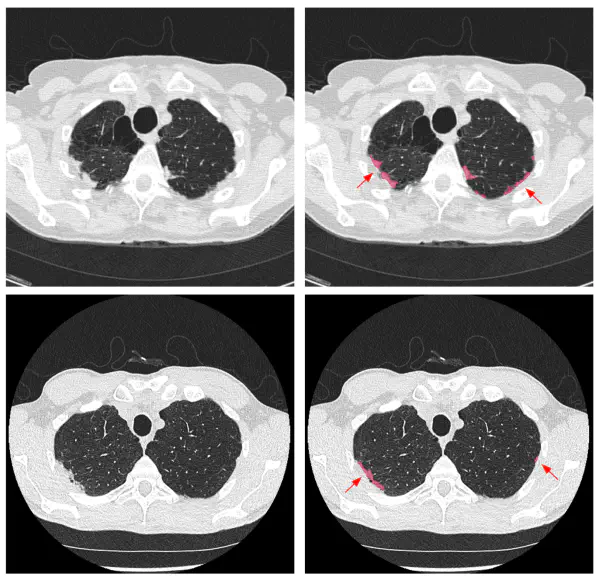 Automated PPFE segmentation (pink, arrowed) on upper-lobe low-dose CT scans.
Our study on progressive pleuroparenchymal fibroelastosis (PPFE) in lung cancer screening has been published in The Lancet Medical Imaging & Theranostics.
Pleuroparenchymal fibroelastosis (PPFE) is a type of scarring that mainly affects the top of the lungs. Using repeat CT scans from over 16,500 people in two lung cancer screening studies, the US National Lung Screening Trial and the London-based SUMMIT study, we used an automated deep-learning tool to measure how much PPFE each person had and how quickly it grew. People whose PPFE grew over time were more likely to die during follow-up, and in SUMMIT they were also admitted to hospital more often for lung problems and needed more steroids or antibiotics for chest symptoms. Because these scans are already taken for screening, tracking PPFE could help identify people who need closer respiratory follow-up.
Read the full paper: Association of progressive pleuroparenchymal fibroelastosis and mortality in lung cancer screening cohorts: a retrospective study (open access, doi:10.1016/j.lanmit.2026.100032).